01
What is maple syrup?
Maple syrup is made by concentrating maple sap. It is not the same thing as maple-flavoured table or pancake syrup, and a product's origin, grade and ingredient identity answer different questions.
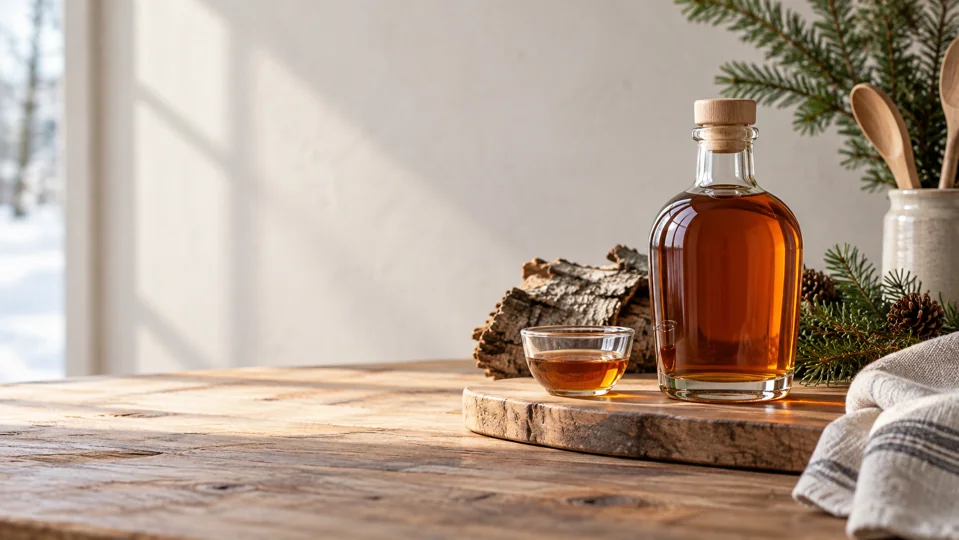
Maple syrup is more than a pancake topping - and less mysterious than much of the marketing around it makes it seem.
Maple syrup is made by concentrating maple sap. It is not the same thing as maple-flavoured table or pancake syrup, and a product's origin, grade and ingredient identity answer different questions.
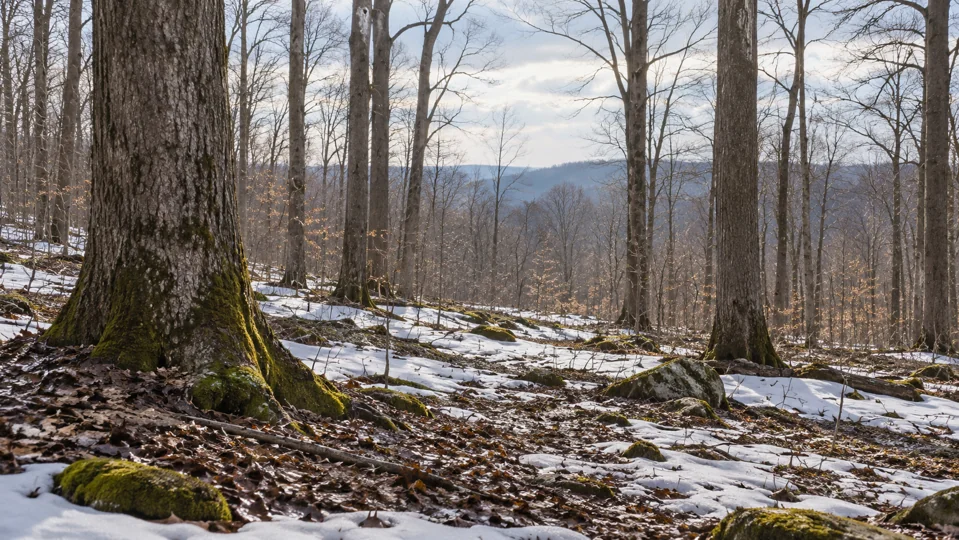
From freeze-thaw conditions and tapping to sap collection, reverse osmosis, evaporation, finishing and grading, modern maple production combines tree biology with careful processing.
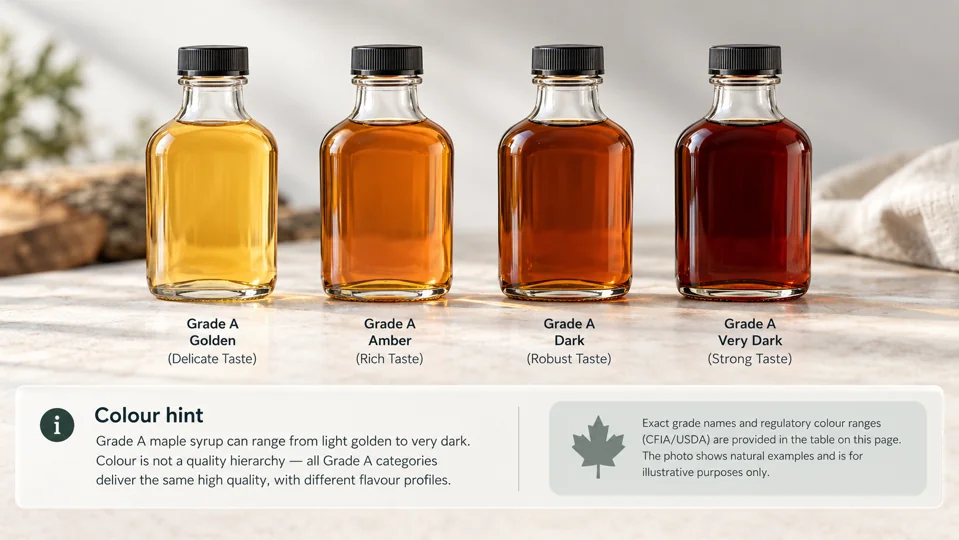
Golden, Amber, Dark and Very Dark are not a ladder from best to worst. In both Canada and the United States, all four can fall within Grade A when the other requirements are met. [3][4]
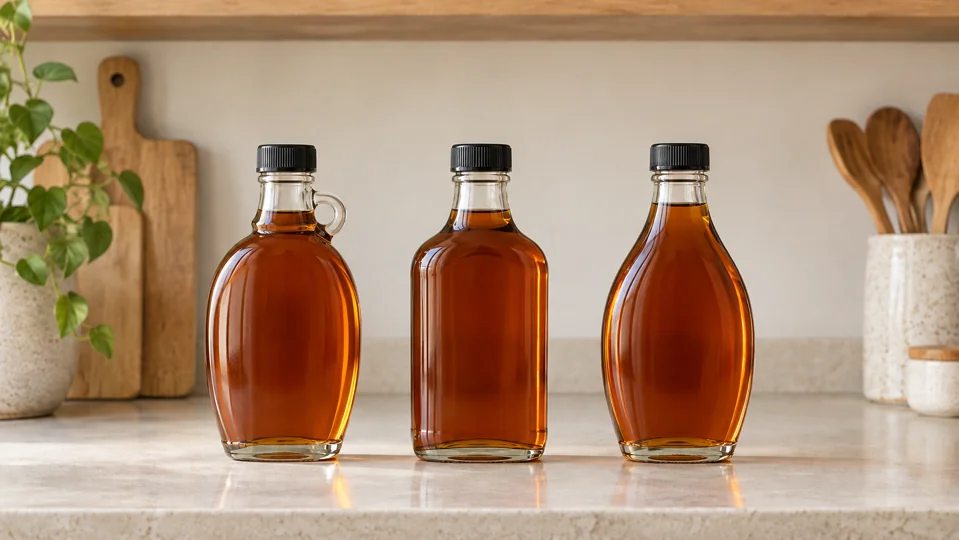
Look first at what the product actually is, then consider origin, grade, colour/flavour, certification, price and how you plan to use it.
MapleSyrup.eu is an evidence-led guide for European consumers who want to understand what maple syrup is, how it is made, where it comes from, what the colour grades mean, how Canada and the United States compare, and what the evidence actually says about nutrition and the European market.
We use official statistics, food standards, legislation and peer-reviewed research wherever they are the strongest source for the question. When the evidence is limited, we say so.
Start with: What Is Maple Syrup? | Canada vs U.S. Maple Syrup
Commercial maple production is concentrated in northeastern North America, with Canada and the northern United States forming the best-documented modern production region.
Canada is the larger producer. Official data put Canadian output at 18.9 million US gallons in 2025, with Quebec accounting for 90.0% of that year's national production. [1]
In the United States, Vermont accounted for 52.6% of reported U.S. maple syrup production in 2026, while New York, Maine, Wisconsin and other northern states also have substantial or established production. [2]
These numbers describe industry scale. They do not establish that one national origin tastes better than another.
Where Maple Syrup Is Made →
Maple Syrup in Canada →
U.S. Maple Syrup →
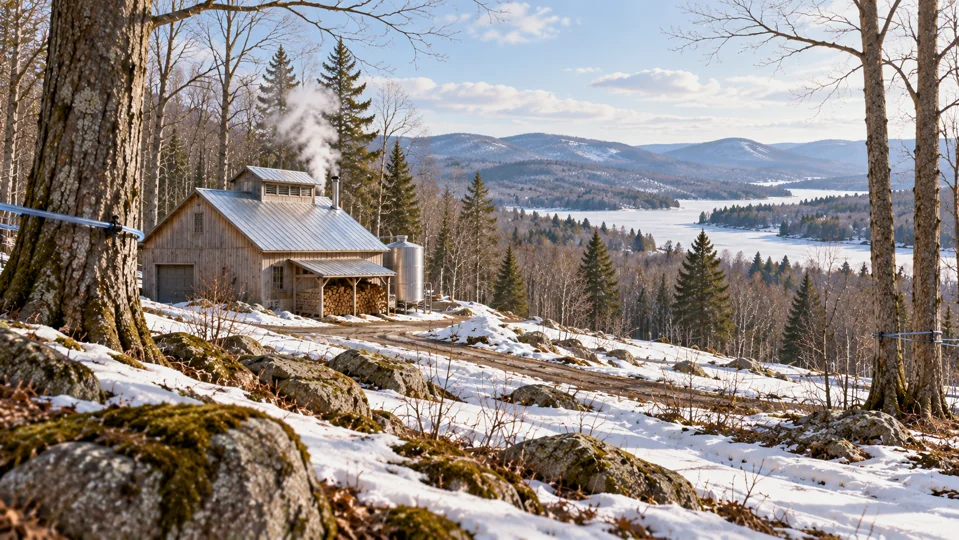
Canada and the U.S. differ markedly in production scale and regional concentration. Their modern Grade A colour and flavour systems, however, are closely aligned.
That makes national origin useful information, but not a quality grade.
Our comparison separates three kinds of claim:
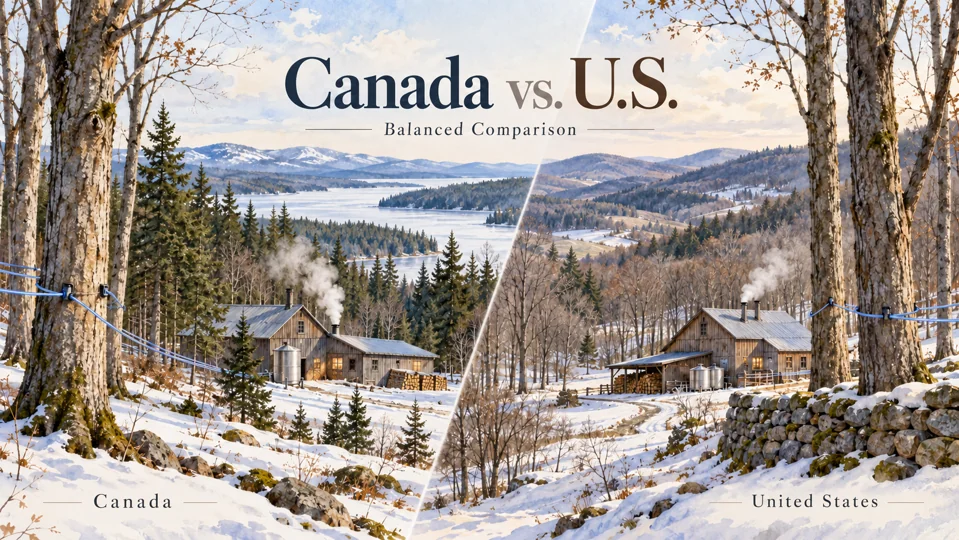
European trade data tell a striking supply-side story.
In 2024, Canada accounted for about 96.6% of recorded EU extra-EU import volume under customs heading HS170220, while the United States accounted for about 1.4%. [5]
There is an important qualification: HS170220 covers "maple sugar and maple syrup" together, so it is not a perfectly syrup-only dataset. Trade flows also do not equal household consumption or shopper preference.
Germany is an important European import and distribution market, and Canadian products have a long-established commercial presence in Europe. But the customs data cannot tell us why an individual shopper chose one bottle over another.
This is exactly the kind of question where a large trade share can be mistaken for consumer evidence.
Our targeted evidence review found no sufficiently robust direct evidence that European consumers prefer Canadian maple syrup over Vermont or other U.S. maple syrup. [6]
Broader European food research shows that country of origin can influence product evaluation and choice. North American maple research also shows that regional origin can matter there. Neither finding proves a specifically European preference for Canada.
So the evidence-led answer is simple: Canadian supply dominance is measurable. A European Canada-over-Vermont consumer preference is not currently established.
All four classes can be Grade A. Open a class to explore its official descriptor.
Illustrative colours, not calibrated grade references. These are flavour-selection cues, not a best-to-worst ranking.
Explore the grading standards →The modern Grade A system gives buyers a practical language for flavour intensity:
Darker does not automatically mean lower quality. The useful question is which flavour profile suits what you want to eat, drink or cook. [3][4]
Understand grades, colour and taste →
Maple syrup contains sugars, measurable minerals and a range of other compounds. But the nutritional starting point remains straightforward: maple syrup is primarily a sugar-rich caloric sweetener. [7]
Research into phenolic compounds and emerging human evidence can be interesting without turning maple syrup into a superfood. We separate composition, laboratory findings, human intervention evidence and permitted health claims rather than blending them into a health halo.
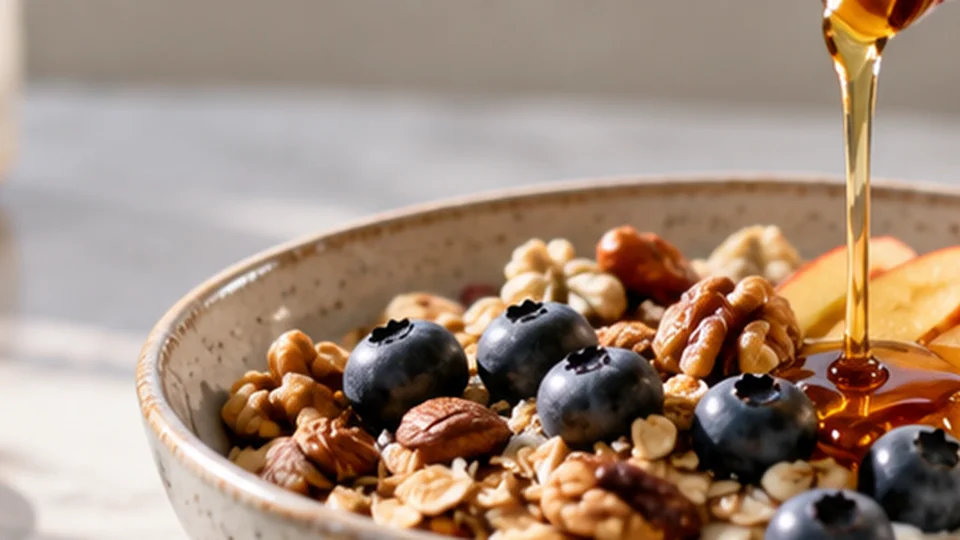
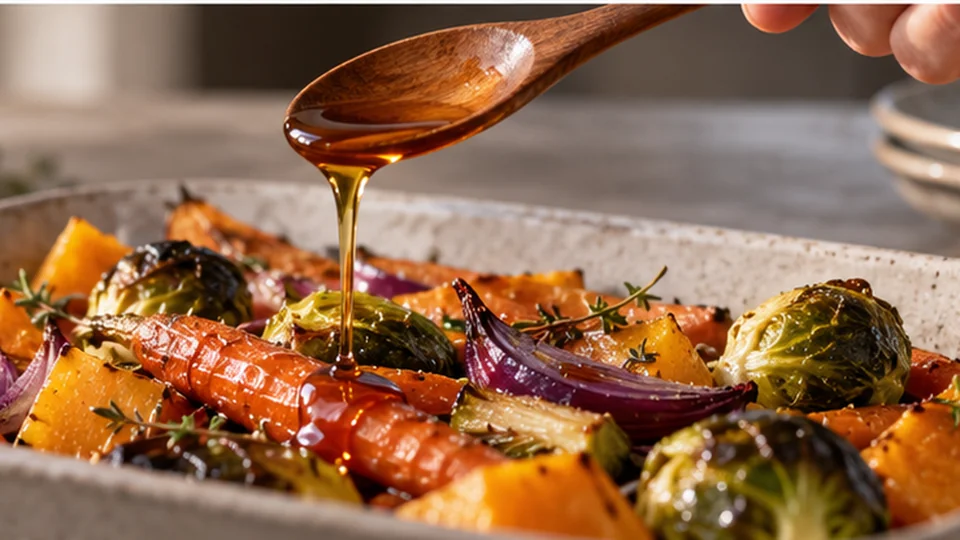
Maple syrup works in far more than breakfast dishes. It can be used in vinaigrettes, roasted vegetables, glazes, pan sauces, baking, desserts and drinks as well as on pancakes or porridge.
Our cooking section treats those uses as practical culinary ideas, not invented traditions. European-inspired applications are presented as contemporary adaptations unless there is evidence for a historical claim. [9]

MapleSyrup.eu is built around a simple editorial rule: a claim should not become stronger than its source.
That means we date changing statistics, separate trade from consumer behaviour, keep U.S. studies attached to U.S. populations, disclose material industry or commissioned-research context, distinguish chemical findings from clinical health evidence, and leave genuine research gaps open rather than filling them with a plausible story.
We also keep generated visuals separate from documentary evidence: maps and numerical charts should be built from verified data, and historically or culturally specific imagery should use authentic sources when factual reconstruction cannot be guaranteed.
Learn the basics
What Is Maple Syrup?
How Maple Syrup Is Made
Explore origin
Where Maple Syrup Is Made
Maple Syrup in Canada
U.S. Maple Syrup
Canada vs U.S. Maple Syrup
Choose and use
Grades, Colour & Taste
Maple Syrup Buying Guide
Cooking with Maple Syrup
Understand the evidence
Maple Syrup in Europe
Maple Syrup Nutrition & Health
Sources, Evidence & Editorial Methodology
Numbered references belong to this article. Dates, definitions and limitations matter.
2025 crop; corrected 16 Dec 2025 · Corrected 2025 production and annual change.
2025 national / 2026 state data used · US production; Vermont 2026 production.
Current checked 10 Sep 2026 · Grade names and colour classes.
Current standard used in dossier · US Grade A colour and flavour classes.
2020-2024 series; 2024 used here · EU extra-EU origin shares.
Through 10 Sep 2026 · Direct maple preference evidence gap. Internal editorial synthesis; the underlying dossier is not publicly hosted.
· Quantitative nutrient profile; record ID fixed in package.
10 Sep 2026 · Evidence ledgers, source registers, publication controls and QA implementation. Internal editorial synthesis; the underlying dossier is not publicly hosted.
Download the complete source register (CSV) ↓ · Our methodology