Canada sits at the centre of the modern maple industry. In 2025, Canadian producers harvested 18.9 million US gallons of maple syrup, with Québec alone accounting for 90.0% of national production. New Brunswick, Ontario and Nova Scotia made up the remaining share. [1][2]
Those numbers explain why Canadian origin is so visible on maple products sold internationally. They do not, however, make "Canadian" a quality grade. A bottle from Canada can be excellent, but nationality alone does not establish that it is better than syrup from Vermont or another US producing region.
For European consumers, the useful way to understand Canadian maple syrup is therefore through four things: scale, geography, standards and trade.
Canada at a glance
Canada produced 18.9 million US gallons of maple syrup in 2025. That was 5.1% below the record harvest of 2024, illustrating that even a very large maple industry can move substantially from one season to the next. [1]
Production is highly concentrated geographically. The 2025 provincial shares reported by Agriculture and Agri-Food Canada were:
- Québec: 90.0%
- New Brunswick: 6.1%
- Ontario: 3.7%
- Nova Scotia: 0.2% [2]
That concentration matters when people use "Canadian maple syrup" as if it described one uniform regional product. Québec is overwhelmingly important, but Canada has meaningful maple production beyond Québec as well.
Canadian production by province · 2025
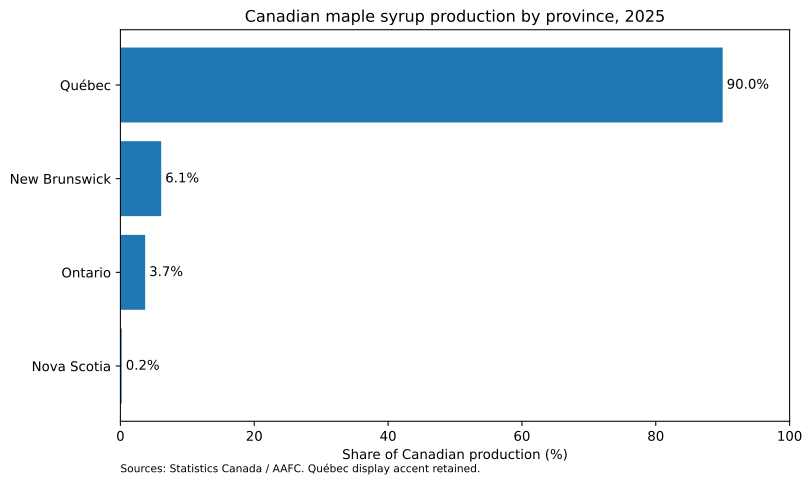
Québec is the centre of Canadian maple production
Québec produced 17.0 million US gallons of maple syrup in 2025, down 5.9% from the previous year's record. It is therefore not merely Canada's best-known maple region; it is the dominant production centre by a very large margin. [1]
This gives Québec an unavoidable place in any serious explanation of Canadian maple syrup. But scale and quality are different questions. A large regional share does not establish that every Québec syrup tastes the same, that Québec syrup is inherently superior, or that maple from other provinces is less authentic.
For V1, MapleSyrup.eu should keep the Québec story focused on what is strongly evidenced: current production scale, its central place within the Canadian sector, and its role in Canadian exports. A later dedicated Québec page can explore cabane à sucre culture, producer institutions and historical development with a deeper cultural source base.
Maple production beyond Québec
The rest of Canada's maple output is much smaller but still worth understanding. In 2025, New Brunswick produced about 1.16 million US gallons, Ontario about 690,000 gallons, and Nova Scotia about 42,000 gallons, according to the official Canadian sources used for this package. [1][2]
New Brunswick accounted for 6.1% of national production and Ontario 3.7%. Nova Scotia's share was 0.2%. [2]
For a launch page, those figures are enough to establish the national picture without pretending that every producing province needs the same depth of treatment as Québec. Separate provincial profiles can come later if they can add genuinely useful information about local production, industry structure or culture.
This also corrects a common simplification: Canadian maple syrup is not synonymous with Québec maple syrup, even though Québec accounts for the overwhelming majority of production.
Canada's maple output changes from year to year
The 2025 harvest should not be described as an all-time record. Official data show that Canadian production declined 5.1% from the record 2024 season. [1]
The longer AAFC series also shows substantial year-to-year movement. Production expressed in syrup equivalent was about 68.0 million kg in 2021, 104.6 million kg in 2022, 62.7 million kg in 2023, 119.6 million kg in 2024 and 113.4 million kg in 2025. [2]
This volatility is an important part of the maple story. Annual output is shaped by seasonal growing and sap-flow conditions, while the number of taps and production technology also change over time. MapleSyrup.eu should therefore date production claims rather than turning one harvest into a timeless description of the industry.
Canada is a highly export-oriented maple supplier
Canada's international reach is one of the clearest characteristics of its maple sector. In 2025, Canada exported 82.4 million kg of maple products with a reported value of approximately C$844.2 million. Canadian maple products were exported to 69 countries. [2]
There is an important category note here. AAFC's export tables define "maple products" as including maple sugar and maple syrup. These figures should therefore not be rewritten as if they measured only bottles of liquid maple syrup.
The United States was by far the largest destination in the detailed 2025 volume table, receiving 64.7% of Canadian maple-product export volume. Germany received 6.8%, the United Kingdom 5.1%, Australia 4.3%, France 4.2% and Japan 3.0%. [2]
The export-value distribution differs slightly. Germany represented 7.2% of Canadian export value in 2025, compared with 6.8% of export volume. Keeping those two measures separate is essential: value share and volume share are not interchangeable.
Why Canada is so visible in Europe
The separate MapleSyrup.eu Europe research confirms that Canada's role is not limited to Canadian export statistics. In 2024, Canada accounted for about 96.6% of recorded EU extra-EU import volume under HS 170220, the customs category covering maple sugar and maple syrup. The United States accounted for about 1.4%. [5]
That is strong evidence of Canadian supply dominance in the recorded European trade category. But it needs the same caution as the Canadian export figures: customs data describe commercial flows, not a controlled consumer choice.
Germany is especially relevant. Canada exported 5.62 million kg of maple products to Germany in 2025, making Germany one of the most important destinations for Canadian maple trade. [2]
For a European information site, the defensible conclusion is therefore that Canadian maple has a very strong established commercial presence. It is not that European shoppers have been proven to prefer Canada when directly offered otherwise comparable Canadian and Vermont products.
Do Europeans choose maple syrup because it is Canadian?
Current research does not allow MapleSyrup.eu to answer that question with a confident yes.
The targeted consumer-evidence review found no sufficiently robust direct evidence that European consumers prefer Canadian maple syrup over Vermont or other US maple syrup. General European food research shows that country of origin can influence consumer evaluation, but that does not establish a specific Canada-over-Vermont maple effect. [6]
Canadian maple promotion in Europe is real and documented, and Canada's trade presence is measurable. What is missing is the behavioural bridge: representative European evidence showing that shoppers consciously choose Canadian origin because of perceived authenticity, quality, national imagery or political sentiment.
This distinction is useful rather than inconvenient. It lets MapleSyrup.eu separate a fact - Canada's exceptional supply presence - from a hypothesis about why individual consumers buy it.
How Canadian maple syrup is graded
Canada has a formal maple-syrup grading framework administered through federal food regulations and the Canadian Grade Compendium. For maple syrup that is not imported, the two grade names are Canada Grade A and Canada Processing Grade. [3][4]
Canada Grade A is divided into four familiar colour and flavour classes:
- Golden, Delicate Taste
- Amber, Rich Taste
- Dark, Robust Taste
- Very Dark, Strong Taste [3]
These classes are much more useful to a buyer than treating Canadian nationality as a quality ranking. The separate MapleSyrup.eu grades page will explain the official colour thresholds and how the Canadian system compares with the US system.
One particularly important point is that darker syrup is not automatically lower quality. Dark and Very Dark are legitimate Grade A colour classes when the product meets the other applicable Grade A requirements. [3]
Does "Canadian" mean better maple syrup?
No evidence in the MapleSyrup.eu research supports a national quality hierarchy in which Canadian maple syrup is inherently better than syrup from Vermont or elsewhere in the northern United States.
Canada differs from the United States dramatically in production scale and export reach. Québec and Vermont also occupy very different positions within their respective national industries. But modern Canadian and US Grade A colour systems are closely aligned, and the research did not locate robust evidence proving Canadian sensory superiority as a national category.
For consumers, declared origin is still useful information. It tells you where the product comes from and can carry cultural or regional meaning. It simply should not be mistaken for an objective quality score.
What should a European buyer look for?
If you are choosing maple syrup in Europe, Canadian origin can be one meaningful piece of information, but it should sit alongside more direct product cues:
- whether the product is genuine maple syrup rather than a maple-flavoured table syrup;
- the declared country or region of origin;
- the grade and colour/flavour class where provided;
- the ingredient and label information;
- certification claims where relevant;
- price and intended culinary use.
Canada's scale helps explain why Canadian syrup is so common in European trade. It does not remove the need to evaluate the actual product in front of you.
For more detail, see Canada vs U.S. Maple Syrup, Maple Syrup in Europe, Maple Syrup Grades, Colour & Taste and the Maple Syrup Buying Guide.
The evidence-based takeaway
Canada's importance to maple syrup is not a marketing invention. The current official data show a national harvest of 18.9 million US gallons in 2025, with Québec accounting for 90.0% of production. Canadian maple products also have a large international export footprint, including a strong presence in major European markets. [1][2]
What the evidence does not support is turning that scale into a quality verdict. Canadian origin is meaningful provenance, not proof that one bottle is automatically better than syrup from Vermont, New York, Maine or another producing region.
For MapleSyrup.eu, that distinction is central: Canada deserves major editorial prominence because the data justify it - not because origin alone is a substitute for evidence about quality.
Sources & reading notes
Numbered references belong to this article. Dates, definitions and limitations matter.
- Statistics Canada
The Daily - Maple products, 2025 ↗2025 crop; corrected 16 Dec 2025 · Corrected 2025 production and annual change.
- Agriculture and Agri-Food Canada
Statistical overview of the Canadian maple industry, 2025 ↗2025 data; published 2026 · Canadian exports; Germany volume/value shares.
- Canadian Food Inspection Agency
Canadian Grade Compendium: Volume 7 - Maple Syrup ↗Current checked 10 Sep 2026 · Grade names and colour classes.
- Government of Canada / Justice Laws
Safe Food for Canadians Regulations ↗Current through 2026 source check · Regulatory framework and maple-product definition.
- UN Comtrade via World Bank WITS
HS 170220 trade data ↗2020-2024 series; 2024 used here · EU extra-EU origin shares.
- MapleSyrup.eu Targeted Deep Research 2
Canadian Origin, Vermont and European Consumer AwarenessThrough 10 Sep 2026 · Direct maple preference evidence gap. Internal editorial synthesis; the underlying dossier is not publicly hosted.
Download the complete source register (CSV) ↓ · Our methodology