Buying maple syrup should be simple: choose a bottle and take it home. In practice, European shelves and online shops can place genuine maple syrup beside table syrups, pancake syrups, maple-flavoured products and packages covered in maple leaves. The most useful buying skill is therefore label literacy, not brand mythology.
There is no single objectively "best" maple syrup for every buyer. A better question is whether the product is actually the type of maple syrup you want, whether the origin and grade information mean what you think they mean, and whether the flavour profile, pack size, certification and price fit your priorities.
This guide uses Canadian maple standards as a clear product-identity reference and EU food-information law for the European consumer context. Where rules are jurisdiction-specific, they are identified as such.
The 60-second maple syrup checklist
If you want the short version, check eight things: product identity, ingredients, origin wording, grade/colour, organic certification if relevant, packaging practicality, comparable price and the storage instructions on the pack.
That sequence matters. A beautifully designed bottle with a maple leaf tells you less than a precise product name and label. Likewise, a high price or pale colour does not create a superior grade by itself.
1. Start with product identity, not the front-of-pack image
The first question is simple: is this product actually maple syrup?
Canadian standards give a useful technical reference. They define maple syrup as a maple product obtained exclusively from maple sap or a maple product under the Canadian standard. Canadian labelling guidance separately gives examples of table-type substitute syrups made from sugar, water and maple flavouring, sometimes with some maple syrup added. [1][2][3]
Those are Canadian legal and regulatory examples, not universal European product-name definitions. For a European shopper, the practical lesson is broader: read what the food says it is, and do not assume that every breakfast syrup with maple imagery is the same product as maple syrup.
Your 60-second bottle check.
Use the label, not the look of the bottle. Tick the points as you go.
0 of 8 checks complete
2. Read the ingredient information - but understand the single-ingredient exception
Where an ingredient list is present, it is one of the quickest ways to distinguish a single maple product from a multi-ingredient syrup. If the list contains other sugars, flavourings or additional ingredients, you are looking at a different formulation from a single-ingredient maple syrup.
At the same time, the absence of an ingredient list is not automatically a warning sign. EU food-information law allows the ingredient list to be omitted for certain foods consisting of a single ingredient when the food name is identical to the ingredient name or clearly identifies the nature of that ingredient. [6]
The practical rule is therefore not "no ingredient list = suspicious". It is: use the product name, any ingredient information provided and the rest of the mandatory food information together.
3. Treat "100% pure maple syrup" as a product description, not a health grade
"100% pure maple syrup" is useful consumer language when it describes a product whose identity is maple syrup rather than a multi-ingredient breakfast syrup. But MapleSyrup.eu does not treat "pure" as a special EU maple-syrup grade, a health claim or a guarantee of superior taste.
The foundation research did not establish one maple-specific EU statutory definition that turns the word "pure" into a universal quality category. The safest approach is to check what the product actually is rather than letting one marketing word carry more meaning than the evidence supports. [9]
4. Read country and region of origin literally
Origin can be genuinely useful information. You may prefer a Canadian product, a Vermont syrup or a product from another producing region for reasons of interest, provenance or personal preference. But origin is not itself a quality grade.
EU food-information rules require information not to mislead consumers, including about identity and origin or provenance. Country-of-origin information is mandatory in defined circumstances, including where leaving it out could mislead consumers about the true origin or provenance of a food. That does not mean every maple syrup bottle must always carry the same origin statement in every situation. [6]
For shopping purposes, read the actual wording. "Product of Canada" or a clearly stated origin conveys something different from a maple leaf, a Canadian-sounding brand or a distributor address. Likewise, "bottled in Germany" describes a bottling location; it does not automatically mean that the maple syrup originated in Germany.
EU rules can also require information about the origin of a primary ingredient where the food itself is presented as having a different origin, in defined cases. The exact application can be legally technical, so this V1 guide does not turn that rule into a package-by-package compliance test. [7]
5. Use Grade A to choose colour and flavour - not a national winner
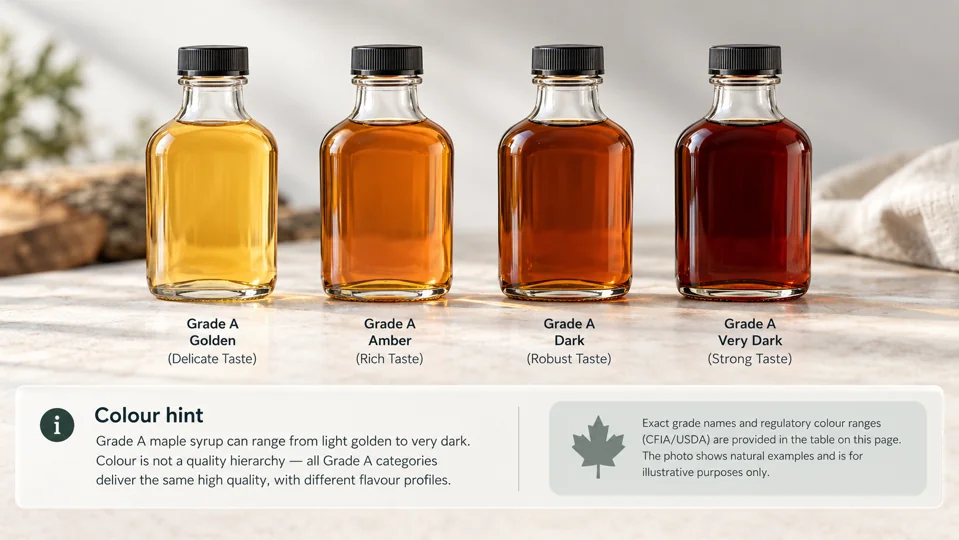
Imported Canadian and U.S. maple syrups may carry familiar Grade A terminology. In both modern systems, Grade A spans four main colour/flavour classes: Golden/Delicate, Amber/Rich, Dark/Robust and Very Dark/Strong. [4][5]
The important buying point is that Dark and Very Dark are not automatically lower quality. They can be fully Grade A. Colour is therefore a flavour-selection clue rather than a simple ladder from "best" to "worst".
If you want a lighter, more delicate maple character, Golden may suit you. If you want a stronger maple profile, Dark or Very Dark may be attractive. Those are flavour preferences, not evidence that one class is objectively superior. The dedicated Grades, Colour & Taste guide explains the thresholds and standards in detail.
6. What does organic maple syrup tell you?
If organic production matters to you, look for the applicable organic certification and labelling information. Organic production and labelling are governed by a dedicated EU legal framework. [8]
What organic does not do is replace all the other buying questions. It is not a maple syrup grade. It does not by itself prove that a syrup tastes better, is nutritionally superior, has zero pesticide residues in an absolute sense or has the lowest environmental footprint.
The detailed certification pathway for an imported Canadian organic maple syrup can be complex. MapleSyrup.eu therefore keeps the V1 buying advice at the consumer level rather than presenting an oversimplified import-certification flowchart.
7. Glass, plastic or metal: choose the package, not a mythology
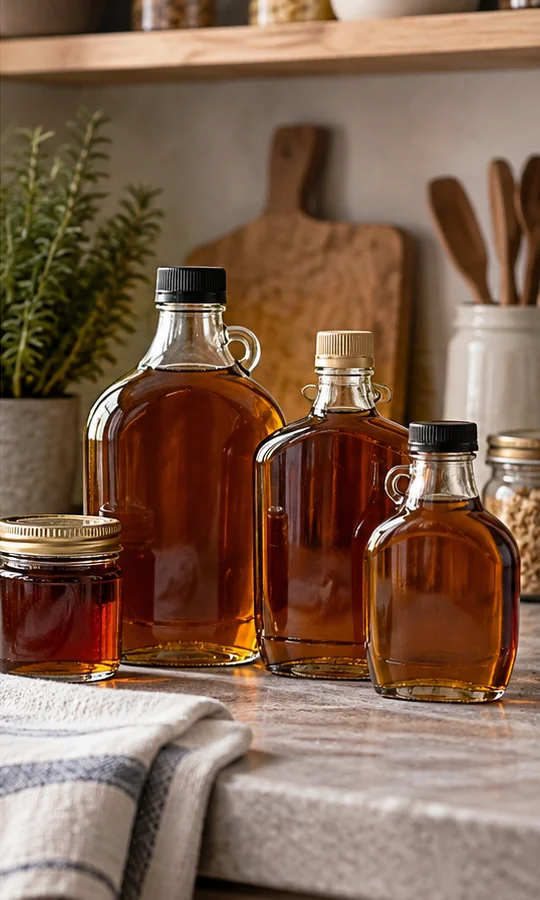
Maple syrup is sold in glass, plastic and metal containers. The foundation research did not identify a sufficiently strong comparative evidence base to declare one packaging material universally best for product quality and environmental performance at the same time. [9]
For V1, the sensible shopping questions are practical: is the pack size right for how quickly you will use it, is it easy to reseal, is breakability important in your household, and what do local disposal or recycling instructions say?
Do not assume that glass automatically means premium syrup, that plastic means lower quality, or that a metal container necessarily preserves syrup better. Those are stronger claims than the current evidence supports.
8. Compare price carefully
Price can matter, especially because genuine maple syrup is a concentrated agricultural product that is often sold in relatively small packages. But price by itself is not a regulated quality score.
When comparing products, first make sure you are comparing the same type of food and similar package volumes. A simple price-per-100 ml or price-per-litre comparison can be more useful than comparing bottle prices alone. MapleSyrup.eu does not publish invented "normal" European price ranges in V1 because the foundation research did not establish a robust comparable retail-price panel.
A more expensive bottle may reflect many commercial factors, but the price alone does not prove that the syrup has a better flavour, a higher grade or a superior origin.
9. Storage: follow the product instructions for now
Storage is important, but it is also an area where confident internet advice can outrun the evidence. The foundation research did not secure a sufficiently complete, current authority-source package for universal statements about unopened shelf life, exact refrigerator duration, freezing or mould management. [9]
For the V1 buying guide, the safe advice is therefore simple: read and follow the storage instructions on the product you buy. A separately sourced MapleSyrup.eu storage guide can address the detailed questions later.
This is deliberate evidence discipline, not a missing shopping tip. It is better to give less advice than to repeat a food-safety rule that has not been properly verified.
10. Labels and claims worth looking at more closely
Some package features deserve a second look rather than an automatic conclusion. Maple-leaf imagery is not the same thing as an origin statement. "Bottled in" is not automatically the same thing as "produced in" or "origin". "Pure" is not a health grade. "Organic" is not a taste ranking. Grade A does not mean that Golden is better than Dark.
Likewise, a maple-flavoured or table syrup should not be dismissed with the imprecise label "fake". It may be a perfectly legitimate food with a different formulation. The useful question is whether it is the product you intended to buy.
So which maple syrup should you buy?
If your goal is genuine maple syrup, start with product identity and label information. Then choose the colour/flavour class that appeals to you. Treat origin as provenance information rather than an automatic quality verdict. Choose organic if that production standard matters to you, select a practical package size and compare prices on a like-for-like basis.
For most shoppers, that is enough. You do not need a national stereotype, a health halo or a packaging myth to choose well.
MapleSyrup.eu will keep deeper questions - storage, detailed organic-import compliance and packaging lifecycle comparisons - separate until the evidence for those questions is strong enough.
Sources & reading notes
Numbered references belong to this article. Dates, definitions and limitations matter.
- Canadian Food Inspection Agency
Canadian Standards of Identity: Volume 6 - Maple Products ↗Current document; modified 28 Apr 2021 · Direct standard of identity for maple syrup and maple sugar.
- Government of Canada / Justice Laws
Safe Food for Canadians Regulations ↗Current through 2026 source check · Regulatory framework and maple-product definition.
- Canadian Food Inspection Agency
Labelling requirements for maple products ↗Current checked 10 Sep 2026 · Grading/labelling framework; future Buying Guide.
- Canadian Food Inspection Agency
Canadian Grade Compendium: Volume 7 - Maple Syrup ↗Current checked 10 Sep 2026 · Grade names and colour classes.
- USDA Agricultural Marketing Service
United States Standards for Grades of Maple Syrup ↗Current standard used in dossier · US Grade A colour and flavour classes.
- European Union / EUR-Lex
Regulation (EU) No 1169/2011 on the provision of food information to consumers ↗Consolidated/current framework · Fair information, ingredient-list exceptions, origin/provenance framework.
- European Union / EUR-Lex
Commission Implementing Regulation (EU) 2018/775 on indication of origin of the primary ingredient ↗Applicable current law · Primary-ingredient origin rule when food origin/provenance is indicated in defined cases.
- European Union / EUR-Lex
Regulation (EU) 2018/848 on organic production and labelling of organic products ↗Applicable current law · EU organic production/labelling framework.
- MapleSyrup.eu project
V1 Content Packages CP01-CP1110 Sep 2026 · Evidence ledgers, source registers, publication controls and QA implementation. Internal editorial synthesis; the underlying dossier is not publicly hosted.
Download the complete source register (CSV) ↓ · Our methodology