Maple syrup is a simple product to recognise and a surprisingly easy subject to oversimplify.
Production statistics can be mistaken for world market shares. Trade flows can be mistaken for consumer demand. A laboratory finding can become a health claim after a few rounds of repetition. A regional tradition can be retold as a national one. And a plausible story about Canada, Vermont or Europe can begin to sound like evidence even when nobody has actually measured it.
MapleSyrup.eu is designed to avoid that pattern.
Our aim is to build a useful English-language resource for European consumers by separating what the evidence establishes, what needs qualification and what is still unknown. That does not mean every page has to read like an academic paper. It means the factual structure behind the page should be strong enough to support the language used in public.
Our basic rule: say only what the evidence supports
The editorial rule is straightforward: a claim should not become stronger than its source.
If an official statistical agency reports maple syrup production for a particular crop year, we can report that number for that year. We should not silently turn it into a timeless fact. If a consumer study was conducted in the northeastern United States, we can describe what that study found in that population. We should not present the result as evidence of how European consumers behave.
When the evidence is strong, MapleSyrup.eu can be clear and confident. When it is limited, the wording should show the limitation. When a useful question cannot be answered reliably, saying so is preferable to filling the space with an assumption.
That principle has practical consequences throughout the site.
For example, our European trade research found that Canada overwhelmingly dominates recorded extra-EU supply in the customs category covering maple sugar and maple syrup. That is strong trade evidence. It is not evidence that European consumers consciously prefer Canadian maple syrup to Vermont or other U.S. origins. A separate review of consumer evidence found no sufficiently robust direct European study establishing that preference. [3][4]
The distinction may be less dramatic than a simple headline, but it is more useful.
Which sources do we prefer?
MapleSyrup.eu uses a source hierarchy as a strong preference rather than an automatic scoring system.
1. Original official and primary sources
For production, trade, regulation and standards, the preferred starting points are the organisations responsible for the data or rules themselves. Depending on the subject, that can include statistical agencies, agricultural departments, food regulators, customs databases and legislation.
Examples used in the current V1 research include Statistics Canada and Agriculture and Agri-Food Canada for Canadian production and exports, USDA National Agricultural Statistics Service for U.S. production, the Canadian Food Inspection Agency and USDA for grading standards, and EU legal or statistical sources for European regulation and trade.
The important point is not the government label by itself. A source still has to address the question being asked. An official source on production cannot be used as evidence of consumer preference simply because it is authoritative in another domain.
2. Peer-reviewed scientific and specialist research
Scientific research becomes especially important for topics such as tree physiology, nutrition and human health.
Here, the type of evidence matters. A paper identifying compounds in maple syrup answers a different question from a controlled human intervention study. An in-vitro antioxidant result is not equivalent to evidence that eating maple syrup prevents disease.
For that reason, MapleSyrup.eu separates composition, laboratory evidence, observational evidence and human intervention evidence rather than combining them into a general "healthy" verdict. [2][6]
3. Industry and commissioned research
Producer organisations, trade groups and commissioned market studies can contain valuable information. They may know their own sector structure, programmes, terminology and marketing activity better than an unrelated source.
But their interests matter.
When an industry organisation describes its own promotional programme, that can be a strong source for the fact that the programme exists. It is not automatically independent evidence that the programme changed consumer behaviour. When a market study was commissioned to help producers develop a market, its methodology and commissioning context should remain visible when we use its findings.
This is particularly important in consumer research, where stated preferences and commercial objectives can easily be turned into stronger claims than the study supports. [4]
4. Journalism and discovery sources
High-quality journalism can be valuable for current events, interviews and context. Specialist sites, archives, blogs and Wikipedia can also help identify terminology, historical leads or original research.
For important factual claims, however, MapleSyrup.eu tries to trace those leads back to the underlying source where reasonably possible. A news article repeating a government statistic is useful context; the government dataset is usually the better citation for the number itself.
Low-quality aggregators, anonymous pages, unsupported SEO content and AI-generated factual material are not treated as authoritative evidence.
How we handle numbers
Numbers often look more precise than the concepts behind them.
Every material statistic should therefore retain four basic pieces of context: what was measured, where, when and in what unit.
Crop year, calendar year, publication year and update year are not interchangeable. If Canada reports a 2025 maple crop and the United States has already published 2026 state data, the newer U.S. figures do not justify comparing a 2026 U.S. region directly with a 2025 Canadian region as if the numbers came from one synchronized dataset.
When MapleSyrup.eu calculates a percentage, the underlying numerator and denominator are retained in the working evidence file. That makes the calculation reproducible and helps prevent a derived percentage from losing its original meaning.
This rule matters for one of the most tempting maple statistics. A calculation showing Canada's share of the combined official Canada-plus-U.S. production total is not a world-production share. The denominator decides what a percentage means.
How we handle trade and market data
Trade statistics are powerful and easy to overinterpret.
They can show that goods entered a country or customs territory, the reported origin or partner, quantity, value and changes over time. They can reveal supply structure and distribution patterns.
They generally cannot tell us who ultimately consumed those goods, why a household bought them, what was available on a particular supermarket shelf, or whether a shopper preferred one origin to another.
Our current European dataset also has a product-classification limitation: the relevant customs heading groups maple sugar and maple syrup together. We therefore label charts and claims accordingly rather than presenting the category as a perfectly syrup-only measure. [3]
Likewise, intra-European redistribution matters. A Canadian-origin product may enter the EU through one Member State and later move to another. Partner-country data must not be casually reinterpreted as agricultural origin.
For MapleSyrup.eu, the rule is simple: trade data describe trade unless another dataset genuinely measures something more.
How we handle consumer research
Consumer evidence must stay attached to the population that was actually studied.
The existing maple research provides a useful example. A substantial Vermont-focused study found that geographic origin can matter to consumers in parts of the northeastern United States. That tells us something real about that market. It does not establish whether a German, French, Dutch or British shopper recognises Vermont, values Canadian origin, or would pay more for one origin than another. [4]
Broader European food research supports the general idea that country of origin can influence product evaluation and choice. But a general mechanism is not the same as a maple-specific effect.
This is why the site may sometimes say: "No sufficiently robust direct evidence located." That is not a failure to answer the question. It is the answer the available evidence supports.
How we handle nutrition and health claims
Nutrition requires an especially conservative evidence ladder.
Maple syrup is a sugar-rich caloric sweetener. It also contains measurable minerals and a range of other compounds. Those facts can coexist without producing a "superfood" conclusion.
MapleSyrup.eu separates several levels of evidence:
- Nutrient composition - what validated food-composition data measure.
- Chemical identification - which compounds researchers have detected.
- Laboratory or preclinical evidence - what happens in cells, chemical assays or non-human models.
- Human intervention evidence - what controlled studies actually observe in people.
- Permitted health or nutrition claims - a separate regulatory question, particularly in the EU.
A finding at one level is not silently promoted to the next. One human study can be interesting and worth reporting while still being insufficient for a universal claim that maple syrup is "healthier than sugar". Funding and material study limitations also remain part of the evidence assessment. [6]

How we handle origin, quality and national comparisons
Country and region of origin are useful information. They are not quality grades.
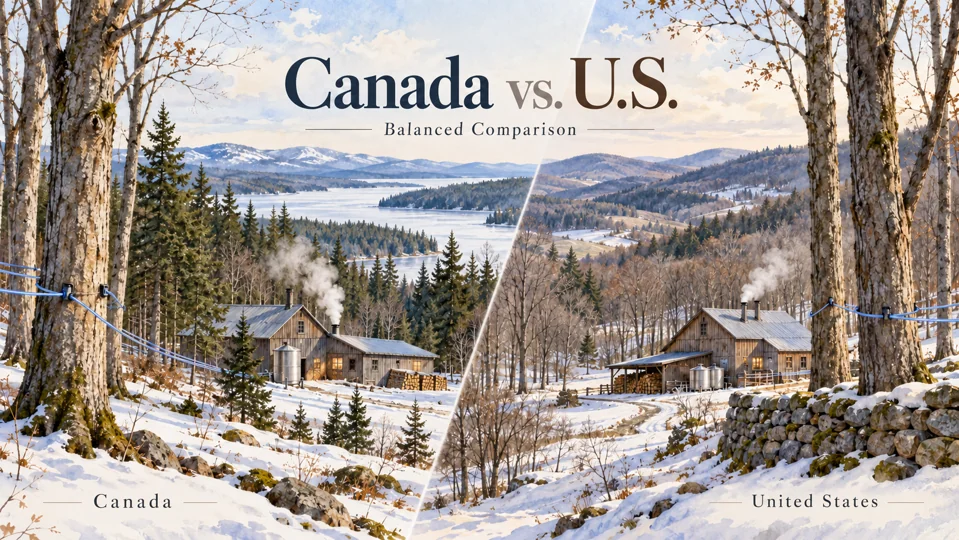
Canada has the larger national maple industry in the synchronized official comparison used on this site. Quebec dominates Canadian production, while Vermont leads U.S. production. Canadian and U.S. Grade A colour/flavour systems are also closely aligned. None of those facts creates an evidence-based national winner for taste or quality.
Accordingly, MapleSyrup.eu avoids claims such as "Canadian maple syrup is objectively better" or "Vermont maple syrup is inherently more artisanal" unless a future source directly measures the specific proposition.
Regional identity deserves to be explained. National stereotypes do not substitute for product evidence.
What happens when sources disagree?
Conflicting figures are not always evidence that one source is wrong.
Differences can arise because sources refer to different crop years, use different units, revise preliminary figures, define product categories differently, distinguish origin from dispatch, or use different valuation methods.
Where a discrepancy matters, the editorial process should first look for the reason. If the difference cannot be resolved confidently, the disagreement should remain visible rather than being silently removed.
The same principle applies when a newer official source corrects an earlier figure. The current V1 work has already encountered such cases, and the corrected primary source is then carried forward with its date and scope rather than leaving the earlier number in place.
How research gaps are treated
A research gap is not a blank that must be filled.
The current project has deliberately left several attractive claims unmade because the evidence is not strong enough. We do not currently have robust direct evidence that European consumers prefer Canadian maple syrup to Vermont maple syrup. We do not have a universal product-level carbon footprint that can be applied to all maple syrup. We do not have enough evidence to rank glass, plastic and metal packaging as one universal sustainability hierarchy.
Those gaps can become future research questions. Until then, they remain gaps.
This approach also keeps the launch practical. MapleSyrup.eu does not need to research every possible question before publishing a useful first version. It needs enough evidence for the claims it actually makes.
How we use AI and generated visuals
AI-assisted tools can help with drafting, organisation, visual ideation and production workflows. They do not become factual sources merely because they can produce fluent text or realistic imagery.
For factual editorial content, claims must remain tied to the underlying research and source register rather than to an AI model's unsupported memory or inference.
The same rule applies visually. A generated image may be appropriate for a general editorial still life, a neutral maple-syrup bottle or an illustrative concept. It should not be used as false documentary evidence for a named farm, a historical event, a specific Indigenous practice, an official label or a regulated technical standard.
Maps and numerical charts are built from verified structured data. Historically or culturally specific imagery should use authentic, archival or licensed material when an accurate reconstruction cannot be guaranteed.
Dates, updates and corrections
MapleSyrup.eu contains both evergreen explanations and time-sensitive data.
Dynamic figures should carry their reference year, and pages that depend materially on annual production, trade or regulatory data should show when they were last fact-checked. Updating a number also means checking whether the definition or dataset changed; replacing the year alone is not enough.
When a material factual error is identified, the intended editorial practice is to correct it, update the supporting evidence record and, where the change is important to a reader's understanding, make the correction visible rather than silently preserving a misleading statement.
This is a maintainable principle rather than a promise that every page can be continuously current. The date and scope of the evidence matter.
What readers should expect from MapleSyrup.eu
Readers should expect MapleSyrup.eu to be confident where the evidence is strong and restrained where it is not.
That means:
- important numerical claims should be traceable to a defined source and period;
- source interests and study limitations should matter to interpretation;
- Canadian and U.S. maple should be compared without manufacturing a national quality winner;
- North American consumer studies should not be presented as European evidence;
- trade data should not be presented as proof of consumer preference;
- health claims should not be inferred from chemistry alone;
- uncertainty and research gaps should be stated rather than hidden;
- visual accuracy should follow the same evidence standard as written accuracy.
The objective is not to publish the largest possible collection of maple-syrup claims. It is to make each published claim useful, proportionate to the evidence and clear about its limits.
That is the editorial standard behind MapleSyrup.eu.
The source library
The complete supplied register is available as a download, including publishers, source periods, uses and limitations.
Download the source register ↓SRC-001 · Maple products, 2025
Statistics Canada · 2025 crop
Canada and Québec production as captured in foundation research
SRC-002 · Crop Production, June 2026
USDA National Agricultural Statistics Service · 2025 national / 2026 state data used
US production; Vermont 2026 production
SRC-003 · Canadian Grade Compendium: Volume 7 - Maple Syrup
Canadian Food Inspection Agency · Current in research dossier
Canadian Grade A requirements and colour classes
SRC-004 · United States Standards for Grades of Maple Syrup
USDA Agricultural Marketing Service · Current standard used in dossier
US Grade A colour and flavour classes
SRC-005 · Combined Nomenclature 2026
European Commission / EUR-Lex · 2026
HS/CN 170220 product-scope caveat
SRC-006 · User manual on international trade in goods statistics - 2026 edition
Eurostat · 2026
Origin vs consignment; trade interpretation
SRC-007 · Statistical overview of the Canadian maple industry, 2025
Agriculture and Agri-Food Canada · 2025 data; published 2026
Canadian exports; Germany volume/value shares
SRC-008 · HS 170220 trade data
UN Comtrade via World Bank WITS · 2020-2024 series; 2024 used here
EU extra-EU origin shares
SRC-009 · How does origin labelling on food packaging influence consumer product evaluation and choices? A systematic literature review
John Thøgersen · 2023
General country-of-origin mechanism; not maple-specific
SRC-010 · Identifying Market Opportunities for Vermont Maple Syrup Producers
Atlantic Corporation / Vermont Agency of Agriculture, Food and Markets · Survey 2020-21
Vermont origin preferences; contextual only
SRC-011 · Minister MacAulay announces new funding to help promote Canadian maple syrup around the world
Agriculture and Agri-Food Canada · 29 Apr 2024
Promotion activity; not campaign effectiveness
SRC-012 · User manual on international trade in goods statistics - 2026 edition
Eurostat · 2026
Origin vs consignment and trade methodology
SRC-013 · Canadian Origin, Vermont and European Consumer Awareness
MapleSyrup.eu Targeted Deep Research 2 · Through 10 Sep 2026
Direct maple preference evidence gap
SRC-014 · Table 51000-0016
Destatis / GENESIS · 2006-2025 infrastructure
German CN8 reproducibility
SRC-015 · The Daily - Maple products, 2025
Statistics Canada · 2025 crop; corrected 16 Dec 2025
Corrected 2025 production and annual change
SRC-016 · Canadian Grade Compendium: Volume 7 - Maple Syrup
Canadian Food Inspection Agency · Current checked 10 Sep 2026
Grade names and colour classes
SRC-017 · Safe Food for Canadians Regulations
Government of Canada / Justice Laws · Current through 2026 source check
Regulatory framework and maple-product definition
SRC-018 · Labelling requirements for maple products
Canadian Food Inspection Agency · Current checked 10 Sep 2026
Grading/labelling framework; future Buying Guide
SRC-019 · Maple Syrup Grades & Standards
USDA Agricultural Marketing Service · Current page checked 10 Sep 2026
Federal Grade A framework and Processing Grade overview
SRC-020 · 2026 Vermont Maple Season Production Once Again Leads the Nation
Vermont Agency of Agriculture, Food and Markets · 2026 crop; 11 Jun 2026
Vermont production and tap-count cross-check
SRC-021 · Operational procedure: Maple syrup grade verification
Canadian Food Inspection Agency · Current procedure checked 10 Sep 2026
Inspection context and soluble-solids/colour verification
SRC-022 · Canadian Standards of Identity: Volume 6 - Maple Products
Canadian Food Inspection Agency · Current document; modified 28 Apr 2021
Direct standard of identity for maple syrup and maple sugar
SRC-023 · Experimental and computational comparison of freeze-thaw-induced pressure generation in red and sugar maple
Maryam Zarrinderakht et al. · Tree Physiology 44(4), 2024; published 11 Jan 2024
Peer-reviewed physiology of freeze-thaw sap exudation; supports cautious mechanism explanation
SRC-024 · 1946-1964 - NRC history: membrane technology / reverse osmosis
National Research Council Canada · Current NRC page; historical technology overview
NRC states maple producers can filter up to 80% of water from sap before syrup making, saving energy costs/consumption
SRC-025 · Bulletin #7040: Getting Geared Up for Maple Sugaring - Supplies and Equipment Needed for 50 to 500 Taps
University of Maine Cooperative Extension · Current extension guidance; accessed 10 Sep 2026
Buckets, food-grade tubing, mainlines and vacuum as sap-collection options
SRC-026 · Bulletin #7038: Maple Syrup Quality Control Manual
University of Maine Cooperative Extension · Updated/revised 2025
Sap quality, tubing, processing, filtering and grading quality-control context
SRC-027 · Maple Syrup Production
Penn State Extension · Current extension page; original publication older
Bucket and tubing collection, vacuum context, prompt handling of sap
SRC-028 · About Maple Syrup
Cornell Maple Program · Current program page; accessed 10 Sep 2026
Tubing/mainline collection, vacuum use among larger producers, evaporation overview
SRC-029 · Regulation (EU) No 1169/2011 on the provision of food information to consumers
European Union / EUR-Lex · Consolidated/current framework
Fair information, ingredient-list exceptions, origin/provenance framework
SRC-030 · Commission Implementing Regulation (EU) 2018/775 on indication of origin of the primary ingredient
European Union / EUR-Lex · Applicable current law
Primary-ingredient origin rule when food origin/provenance is indicated in defined cases
SRC-031 · Regulation (EU) 2018/848 on organic production and labelling of organic products
European Union / EUR-Lex · Applicable current law
EU organic production/labelling framework
SRC-032 · FoodData Central - SR Legacy record "Syrups, maple", FDC ID 169661
U.S. Department of Agriculture, Agricultural Research Service ·
Quantitative nutrient profile; record ID fixed in package
SRC-033 · Maple Syrup: Chemical Analysis and Nutritional Profile, Health Impacts, Safety and Quality Control, and Food Industry Applications
Saraiva A. et al. ·
Composition context; phenolics and other minor compounds; evidence-level framing
SRC-034 · Substituting Refined Sugars With Maple Syrup Decreases Key Cardiometabolic Risk Factors in Individuals With Mild Metabolic Alterations: A Randomized, Double-Blind, Controlled Crossover Trial
Morissette A. et al. ·
Human intervention evidence and limitations
SRC-035 · Regulation (EC) No 1924/2006 on nutrition and health claims made on foods
European Union / EUR-Lex ·
Legal framework distinguishing permitted nutrition/health claims
SRC-036 · Nutrition claims - Food Safety
European Commission ·
Conditions for permitted nutrition claims such as low sugars and source/high nutrient claims
SRC-037 · Health claims
European Food Safety Authority ·
Explains EFSA role in scientific substantiation of health claims
SRC-038 · Maple Syrup Grades, Colour & Taste v0.2
MapleSyrup.eu CP05 · 2026
Locked grading language and visual rule
SRC-039 · Maple Syrup in Canada, v0.2
MapleSyrup.eu CP03 · 10 Sep 2026
Locked Canadian 2025 production geography and source normalisation
SRC-040 · V1 Content Packages CP01-CP11
MapleSyrup.eu project · 10 Sep 2026
Evidence ledgers, source registers, publication controls and QA implementation
SRC-041 · Maple Syrup Nutrition & Health v0.2
MapleSyrup.eu CP09 · 10 Sep 2026
Conservative nutrition positioning
Sources & reading notes
Numbered references belong to this article. Dates, definitions and limitations matter.
- MapleSyrup.eu CP09
Maple Syrup Nutrition & Health v0.210 Sep 2026 · Conservative nutrition positioning. Internal editorial synthesis; the underlying dossier is not publicly hosted.
Saraiva A. et al.
Maple Syrup: Chemical Analysis and Nutritional Profile, Health Impacts, Safety and Quality Control, and Food Industry Applications ↗· Composition context; phenolics and other minor compounds; evidence-level framing.
- UN Comtrade via World Bank WITS
HS 170220 trade data ↗2020-2024 series; 2024 used here · EU extra-EU origin shares.
- MapleSyrup.eu Targeted Deep Research 2
Canadian Origin, Vermont and European Consumer AwarenessThrough 10 Sep 2026 · Direct maple preference evidence gap. Internal editorial synthesis; the underlying dossier is not publicly hosted.
Atlantic Corporation / Vermont Agency of Agriculture, Food and Markets
Identifying Market Opportunities for Vermont Maple Syrup Producers ↗Survey 2020-21 · Vermont origin preferences; contextual only.
- U.S. Department of Agriculture, Agricultural Research Service
FoodData Central - SR Legacy record "Syrups, maple", FDC ID 169661 ↗· Quantitative nutrient profile; record ID fixed in package.
Saraiva A. et al.
Maple Syrup: Chemical Analysis and Nutritional Profile, Health Impacts, Safety and Quality Control, and Food Industry Applications ↗· Composition context; phenolics and other minor compounds; evidence-level framing.
Morissette A. et al.
Substituting Refined Sugars With Maple Syrup Decreases Key Cardiometabolic Risk Factors in Individuals With Mild Metabolic Alterations: A Randomized, Double-Blind, Controlled Crossover Trial ↗· Human intervention evidence and limitations.
Download the complete source register (CSV) ↓ · Our methodology