
Maple syrup is a North American product with a firmly established European trade presence. But measuring that presence is less straightforward than it first appears. European customs statistics group maple sugar and maple syrup together, products move through distribution hubs inside the EU, and imports are not the same thing as household consumption.
Within those limits, one fact is exceptionally clear: Canada dominates recorded extra-EU supply in the relevant maple customs category. The United States is a much smaller direct supplier, while Germany stands out as an important European import and redistribution market.
The distinction that matters throughout this page is simple: trade data can show where recorded supply comes from and how it moves. They cannot tell us why an individual consumer chose a bottle, how much households consumed, or whether Europeans consciously prefer Canadian maple syrup to Vermont or other US syrup.
First, a customs-data caveat: "maple syrup" is not isolated perfectly
At international HS level, code 170220 is defined as "Maple sugar and maple syrup". The EU Combined Nomenclature keeps the same combined heading. Its 2026 subdivisions separate a narrow type of solid maple sugar with added flavouring or colouring from an "Other" category, but ordinary maple syrup still sits inside a residual category rather than a clean syrup-only statistical code. [1]
That means trade charts based on HS 170220 should be labelled "maple sugar and maple syrup", not simply "maple syrup imports". For a consumer site, this is more than a technical footnote: it prevents a precise-looking customs number from being presented as something the dataset does not actually isolate.
EU extra-EU supply by origin · 2024
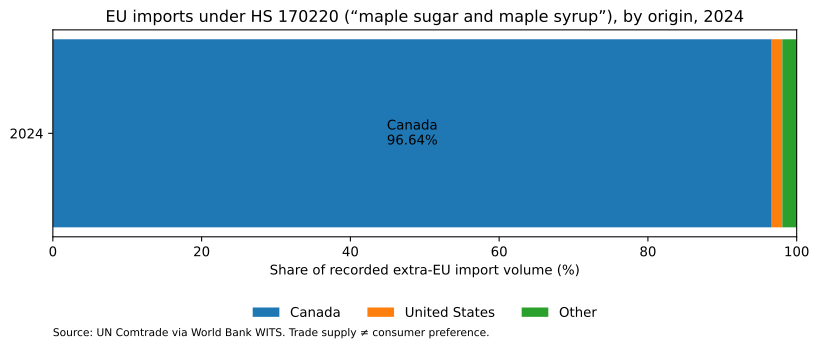
Canada overwhelmingly dominates recorded extra-EU supply
For the most recent fully reproducible harmonised origin comparison in the targeted research, the EU recorded 12.906 million kilograms of extra-EU imports under HS 170220 in 2024, worth about US$101.699 million. Canada supplied 12.473 million kilograms of that total. The United States supplied 184,055 kilograms. [3]
That corresponds to about 96.64% from Canada, 1.43% from the United States and 1.93% from all other extra-EU origins combined by volume.
The Canadian share was not a one-year anomaly. Across the harmonised 2020-2024 series, Canada represented roughly 94.8% to 96.8% of recorded EU extra-EU import volume in this customs category. The US share remained roughly 1.2% to 2.0%. [3]
This is strong evidence that Canada's commercial role in European maple supply is much larger than that of the United States. It is not a consumer-preference result.
Has European maple trade been growing rapidly?
The five-year volume series does not support a simple story of continuous rapid growth. Recorded EU extra-EU quantity rose from 12.09 million kg in 2020 to 13.81 million kg in 2021, then moved to 13.29 million in 2022, 13.32 million in 2023 and 12.91 million kg in 2024. [3]
On that basis, 2024 volume was about 6.7% above 2020 but about 6.6% below the 2021 level. Reported nominal import value increased more strongly over the same start-to-end comparison, but value can change because of prices, product mix, exchange rates and freight or insurance valuation as well as physical quantity.
The appropriate description is therefore a sizeable, fluctuating European trade rather than an uninterrupted volume boom.
Which European markets stand out in the trade data?
A 2025 compilation reproduced in Agriculture and Agri-Food Canada's statistical overview identifies Germany, the United Kingdom, France, the Netherlands, Denmark and Italy among the larger European import markets for the combined maple sugar/maple syrup category. [2]
Those country figures are useful for identifying trade-relevant markets, but they should not be treated as a league table of household maple-syrup consumption. Member-State figures can include goods arriving from other EU countries, and the same physical product can move across more than one internal border before reaching its final buyer.
The Netherlands is a good example of why this matters. It appears prominently in the 2025 market compilation and also exported 829,835 kg under HS 170220 in 2024. A high Dutch trade number can therefore reflect distribution and re-export as well as domestic use. Germany also shows a clear redistribution pattern. [2][3]
2025 European trade markets (supplementary dataset): Germany 6,548 t; United Kingdom 5,702 t; France 3,650 t; Netherlands 3,082 t; Denmark 1,932 t; Italy 1,462 t. Label the source as AAFC / Global Trade Tracker and do not combine the values directly with the WITS historical series.
Germany is a major European import and redistribution market
Germany is especially important for MapleSyrup.eu because it is both a large European trade market and a major destination for Canadian maple products.
In the harmonised WITS/UN Comtrade series, Germany reported 4.718 million kg of HS 170220 imports in 2024, worth about US$37.198 million. Canada accounted for 4.489 million kg, or 95.15% of the reported volume. The United States accounted for 35,053 kg, or 0.74%. [3]
Those figures should still not be read as German consumption. Germany itself exported 873,067 kg under HS 170220 in 2024, including flows to Austria, Switzerland, the Netherlands, Hungary and Italy. That onward movement is direct evidence that gross German imports and German household use are not the same measure. [3]
The recent trend is also uneven rather than one-directional. German import quantity was 4.486 million kg in 2020, reached 5.420 million kg in 2021, fell to 4.403 million in 2022 and 4.428 million in 2023, then recovered to 4.718 million kg in 2024. The 2024 level was about 5.2% above 2020 but remained below the 2021 high. [3]
What do the latest Canadian export data say about Germany?
The Canadian export-side data add a more recent 2025 view, but they should be kept separate from the 2024 WITS series because the source, valuation and reporting perspective differ.
According to Statistics Canada data reproduced by Agriculture and Agri-Food Canada, Canada exported 5,618,129 kg of maple products to Germany in 2025, worth about C$60.439 million. Germany represented 6.8% of Canadian maple-product export volume and 7.2% of export value that year. [2]
Canadian recorded exports to Germany increased from 4.612 million kg in 2024 to 5.618 million kg in 2025, a rise of about 21.8% on that export-side series. It would be incorrect to call this a 21.8% rise in German maple demand: the figure measures Canadian shipments to Germany, not total German final consumption.

Why origin and dispatch can tell different stories inside Europe
European trade statistics use different partner concepts depending on the flow. For extra-EU imports, the partner is generally the country of origin. For intra-EU movements, the partner is generally the Member State of consignment. [4]
Consider a simplified example: Canadian maple syrup enters the EU through the Netherlands, clears customs there, is warehoused and later shipped to Germany. The original extra-EU entry can be recorded with Canada as origin, while the later German intra-EU movement can identify the Netherlands as the consignment partner.
This is why a German import recorded from the Netherlands, Spain or another EU country does not demonstrate that the maple product was produced there. It can be part of the European distribution chain.
For the same reason, national gross imports should not be added together and described as "European consumption". The same goods may cross several statistical borders.
What about the United Kingdom?
The UK belongs in a European consumer overview even though it is no longer an EU Member State. In 2024, the UK reported 5.064 million kg of HS 170220 imports. Canada accounted for 4.316 million kg, or about 85.22% of volume, while the United States accounted for 71,651 kg, or about 1.41%. [3]
A sizeable 541,989 kg was reported with Denmark as the partner, another reminder that a European partner country can reflect dispatch and redistribution rather than agricultural origin.
Canadian export-side data for 2025 show 4.190 million kg of maple products shipped from Canada to the UK, equal to 5.1% of Canadian export volume. [2]
Does Canada's trade dominance mean Europeans prefer Canadian maple syrup?
No. The trade evidence and the consumer evidence answer different questions.
The customs data establish that Canadian-origin goods overwhelmingly dominate recorded extra-EU supply in the maple sugar/maple syrup category. Targeted consumer research, however, found no sufficiently robust direct European maple-specific evidence showing that consumers prefer Canadian origin over Vermont or other US origins. [5]
General European food research does show that country of origin can influence product evaluation and choice. But the direction and strength of that effect depend on context, and the literature often includes preferences for domestic or geographically closer food. That evidence cannot be converted into a specifically Canadian maple premium. [6]
Canadian maple promotion in Europe is also real. In 2024, Agriculture and Agri-Food Canada announced up to C$3.6 million in support for Québec Maple Syrup Producers, with Germany and the UK among the named target markets. This proves promotional activity. It does not prove that the campaigns changed awareness, willingness to pay or purchase behaviour. [7]
What trade data can - and cannot - tell a European consumer
What the data establish
- Substantial quantities of goods classified as maple sugar and maple syrup enter Europe.
- Canada is overwhelmingly the principal recorded extra-EU origin.
- Direct US-origin imports are much smaller.
- Germany is an important European import and redistribution market.
- The Netherlands and Germany, among others, participate in onward distribution and re-export.
- Import quantity and value fluctuate over time.
What the data suggest, but do not prove
- Canadian-origin maple products have a much broader import-level commercial presence in Europe than US-origin products.
- Germany is an important commercial node for maple products.
What the data cannot establish
- Household consumption.
- The share of retail shelves occupied by Canadian products.
- Consumer awareness of Canada or Vermont.
- Preference for Canadian origin.
- Willingness to pay for a Canadian or Vermont label.
- Taste or perceived quality differences.
- Political motivation for a purchase.
This separation is the central methodological rule for interpreting European maple trade.
Key takeaway
Europe has a substantial, measurable maple-product trade, but the customs category is broader than bottled maple syrup alone. In the 2024 harmonised extra-EU series used here, Canada supplied about 96.6% of import volume under HS 170220, compared with about 1.4% from the United States. Germany is a major European import and distribution market, and Canadian export data confirm its importance as a destination.
Those are strong supply-side facts. They do not establish that European consumers prefer Canadian maple syrup, reject Vermont syrup or choose products for political reasons. For MapleSyrup.eu, the most useful European story is therefore both clear and limited: Canada dominates recorded supply; consumer motivation remains a separate question.
Sources & reading notes
Numbered references belong to this article. Dates, definitions and limitations matter.
- Agriculture and Agri-Food Canada
Statistical overview of the Canadian maple industry, 2025 ↗2025 data; published 2026 · Canadian exports; Germany volume/value shares.
- UN Comtrade via World Bank WITS
HS 170220 trade data ↗2020-2024 series; 2024 used here · EU extra-EU origin shares.
- Eurostat
User manual on international trade in goods statistics - 2026 edition ↗2026 · Origin vs consignment and trade methodology.
- MapleSyrup.eu Targeted Deep Research 2
Canadian Origin, Vermont and European Consumer AwarenessThrough 10 Sep 2026 · Direct maple preference evidence gap. Internal editorial synthesis; the underlying dossier is not publicly hosted.
- John Thøgersen
How does origin labelling on food packaging influence consumer product evaluation and choices? A systematic literature review ↗2023 · General country-of-origin mechanism; not maple-specific.
- Agriculture and Agri-Food Canada
Minister MacAulay announces new funding to help promote Canadian maple syrup around the world ↗29 Apr 2024 · Promotion activity; not campaign effectiveness.
Download the complete source register (CSV) ↓ · Our methodology